
Quick answer
Keep three things clear: a current medication list, the schedule confirmed by your pharmacist or prescriber, and a separate dated record of what you enter each day. Use paper or a digital medication tracker you can find and update easily. Start with your own information; involve someone you trust when you want support.
One list on the fridge. A photo of a label on your phone. A note about a change that you now have to find again.
Keeping track of medications can become an information problem before you even choose an app. This guide is for people organizing their own care across Canada. Give each kind of information a clear home, with a free printable worksheet, a simple example and personal medication tracking in Cercle.
Vous préférez le français? Lire le guide sur le suivi des médicaments.
This guide is about organization, not treatment. Follow your current professional instructions. A tracker cannot establish whether a medicine was taken. If you are uncertain about a dose, ask your pharmacist or healthcare professional rather than deciding from a blank or uncertain record.
Start here: list, schedule and daily record
These three things are related, but they answer different questions:
- Medication list: What information do I need to keep current?
- Schedule: Which days and times have been confirmed for me?
- Daily record: What did someone explicitly enter about a particular date?
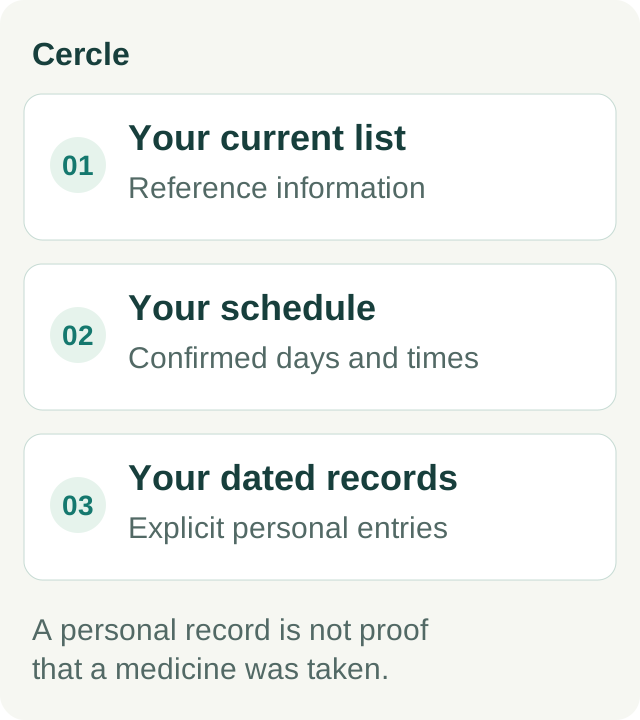
Each part gives your personal medication information a clear purpose. A current list does not tell you what happened today; a checkmark does not confirm that the prescription details are current.
1. Build a medication list you can actually find
Ask your pharmacy for a current list and review it with your pharmacist. Include products obtained elsewhere, non-prescription medicines and supplements in that discussion. Health Canada recommends keeping a record of your medications and discussing medication questions with your healthcare professional.
For your working copy, record:
- The medicine or product name and strength, copied accurately.
- The current professional instructions and where they came from.
- Questions or details to clarify with your pharmacist.
- The date you last reviewed the list.
Keep a question visible instead of filling the answer from memory. Similar-looking names, packaging or icons are not a reliable way to identify medicines.
Keep the latest list in one place you can access at an appointment. If you retain an older copy, mark it clearly so it cannot be confused with the current reference. A personal list supports a conversation with your healthcare team; it does not replace prescription verification.
2. Write down the confirmed days and times
Your schedule should reflect instructions you have confirmed, including applicable weekdays when relevant. Copy the details carefully. Do not convert wording you do not understand into a timetable yourself.
Here is a fictional display example, not a recommended medication schedule:
| Reference | Applicable days | Entered times |
|---|---|---|
| Example medication A | Monday to Friday | 8:00 a.m., noon, 4:00 p.m. |
These three daytime entries do not describe an around-the-clock schedule. If instructions mention an interval, changing times or another detail you are unsure about, ask your pharmacist how to represent it before entering times in a tracker.
Choose readable names and explicit clock times. If you use an icon for convenience, keep the written name alongside it. The icon is a visual aid, not medication identification.
3. Keep dated records separate from the current list
A daily medication record is a place for explicit entries about a particular day. It is different from a list of instructions.
Keep the date being recorded distinct from the time an entry was made. An entry added later may refer to an earlier date. The recording time does not establish when a medicine was taken.
For paper records, use a separate dated page and make corrections visible. In a digital tool, check how it handles earlier entries and edits to the current reference information. Do not assume that historical rows preserve every previous version of a prescription.
A blank entry means only that no record is present. Records can be incomplete, delayed or incorrect. Neither a blank nor a checkmark should be used to decide whether to take, repeat, omit or change a dose. Confirm uncertainty with a pharmacist or healthcare professional.
Free printable medication list and daily record
Want to start on paper? These two blank pages give your information a consistent home:
- Current list and schedule: space for medication references, professional instructions, confirmed days and times, and questions to clarify.
- Dated personal record: space for explicit notes, who recorded them and when, plus clear corrections.
Download the free medication organization worksheet (PDF, 2 pages)
No account or email address is needed. Print as many daily record sheets as you need. Store completed copies thoughtfully: they may contain personal health information. The blank worksheet is an organizational aid, not an official medication chart or a prescription.
Paper, phone note or medication tracker app?
The best fit depends on how you prefer to work. A simple system you maintain is more useful than a detailed one you stop updating.
Paper works well when you want a physical reference. Decide where the current list lives and how older pages will be kept separate. Copies can become outdated, so make the review date easy to find.
A phone note or spreadsheet can keep an editable list close at hand. Label the current reference clearly and give daily notes their own dates. Think about device access, backups and who can read a shared file.
A digital medication tracker may bring references, entered times and dated history together. Before choosing one, check:
- Can you begin for yourself without inviting anyone?
- Are names, times and controls easy to read on your phone?
- Can you enter the weekdays and times you have confirmed?
- Is a current schedule clearly separate from historical records?
- Can you understand who has access and how sharing works?
- Are the plan limits and any paid features explained?
If you use reminders, treat them as an extra convenience. Notifications can be delayed, duplicated or missed. Your arrangements for following professional instructions must work independently of an app notification.
Personal medication tracking with Cercle
Cercle is a personal medication tracker and care coordination tool. Keep your medication list, confirmed schedule, appointments and dated records together in one space for your day-to-day organization. Use it independently, or share access with someone you trust when that is helpful.
- Choose “Myself” during setup. Begin with your own care space.
- Add medication reference information. Use the current details you have confirmed; keep unresolved questions for your pharmacist.
- Enter applicable weekdays and confirmed clock times. Review the written name as well as any icon you choose.
- View medication references in the calendar alongside appointments and everyday tasks. Calendar visibility is an organizational choice, not a change to professional instructions.
- Review dated records when you need context. Check the date an entry concerns and distinguish it from when it was recorded.
- Invite support when you want it. Review the access you give a partner, relative or other trusted person.
Cercle stores user-entered organizational information. It does not verify prescriptions, check interactions, calculate doses or interpret missing records. Current medication references are not a versioned prescription history. Verify records before sharing or using them.
Start organizing my care in Cercle
A free plan is available. See current plans and limits before choosing paid features.
When someone else helps with the records
Agree on what each person will record and how important changes will be confirmed. A shared tool is more useful when everyone understands the difference between current reference information, a scheduled entry and an explicit note.
Keep different people's records separate. Respect the person's choices about sharing and check access when circumstances change. Confirm important information directly rather than assuming everyone has seen an update.
For an upcoming appointment, our doctor visit preparation tool can help you organize what you want to discuss. Review your information before sharing it with a healthcare professional.
Common questions about medication tracking
What is the easiest way to keep track of medications?
Start with a current list, a confirmed schedule and separate dated records. Choose paper or a tool you can maintain. The easiest format is the one you can find and update consistently, rather than the one with the most features.
What should I put on a medication list?
Use accurate names, strengths and current professional instructions, and note when you reviewed the list. Include non-prescription products and supplements in the list you discuss with your healthcare team. Health PEI's medication-list guidance provides a practical reference.
What can I organize with Cercle?
Cercle brings your medication references, confirmed days and times, appointments, everyday tasks and dated records into one care-coordination space. Choose personal setup to organize your own information, with optional sharing when you want support.
What if I cannot remember whether I took a medicine?
A missing or uncertain record cannot reliably answer that question. Contact your pharmacist or healthcare professional for advice specific to the medicine and your situation. Do not decide to repeat or change a dose from the tracker alone.
Does a medication tracker replace a pill organizer?
A tracker organizes information; a pill organizer physically holds medicines. Ask your pharmacist whether an organizer is appropriate for your medicines and storage requirements. Do not identify medicines solely by a picture, colour or compartment.
Can I bring my medication list to an appointment?
Yes. Keep it current and review it with your healthcare professional. HealthLink BC's guidance on keeping track of medicines recommends bringing a master list to doctor visits.
Start with one current list, the schedule you have confirmed and a clear place for dated records. That is a useful foundation whether you prefer paper, use Cercle for yourself or involve someone you trust.
Sources and editorial note
This organizational guide was prepared by Cercle, the product described above. It is not a medical review or personalized medication advice. The worksheet and fictional example were created for this article. Canadian public-health sources are used for general medication-list organization, not to describe province-specific services or coverage. Sources checked on October 29, 2026: